
Deeptime Pickling; Reflections on the Microbiome and the Human Holobiont

The Holobiont is an organism along with all of the microbes that live in on and around it. It is a cloud-like assemblage of critters and genomes interchanging molecules and influencing each-others metabolic processes of life living, of feeling and even of thinking.
It is a term popularised by Lyn Marguilis in the 90s, invented by German theoretical biologist Adolf Meyer-Abich in 1943. Dates are important; these thoughts are very new. The status quo modern conceptualisation of The Human has been traditionally defined as precisely other-than 'Nature'; yet we have since discovered (among many other contradictions) that microbial ecosystems support our bodies functioning, thinking, and feeling processes.1 ‘Microbes orchestrate the adaptive immune system, influence the brain, and contribute more gene functions than our own genome’.2 In terms of sheer mass, roughly half the cells in the human body are microbial.3 We work so hard to keep the bugs off us that we forget that they are us.
Humans have had deep, multi-generational, microbial relations long before modern science's discovery of the microbiome. Cheeses, pickles, sourdough, fermented sauces, beer and wine, yoghurt, kefir, and tofu, make for delicious eco-cultural-gastrological encounters with our tiny microbial kin. The digestion process begins before we even eat them, making the likes of pickles not just a commodity neatly sealed in jars, but a continuation of a multispecies metabolic process.
But where does the Human situate precisely within the holobiont? The entire ecosystem threads outward from us and past us and into us, dipping into other worlds not accessible to the front-end of the human biont. Our microbial tendrils dip into soils, deep oceans, the fields of agriculture, frozen tundras, and landfills. The furthest reaches of the most 'pristine' wilderness is no more lively and wild than the inside of our own intestines.
Cyanobacteria are the original Exxon Mobil of our planetary history and the first climate changers. Billions of years ago they filled our atmosphere with oxygen, making us and our creature ancestors the fizzling and seething coagulation of a planetary deeptime pickling. We are pickles made of pickles. We are human-microbe chimeras, but yet we design our worlds as though we aren't. Our holobiomes are a matter of health, of happiness, of urbanisation long before urbanisation. Yet many of the practises of modernisation pasteurises them into antibacterial, antibiotic oblivion.
Reacting against our attempts to sterilise their wilderness, mutant microbial horrors cause antibiotic resistant diseases like tuberculosis, many chronic health conditions, and depression4. Microbial imbalances have been linked to cognitive diseases like dementia and parkinsons5.
The microbiome seems invisible until it fails, and it shows up when environments change. This makes the microbiome act like a kind of indicator, an early warning system, of what is to come.6 Current indications are grim. Algal blooms in the ocean are already taking some of the first climate casualties.
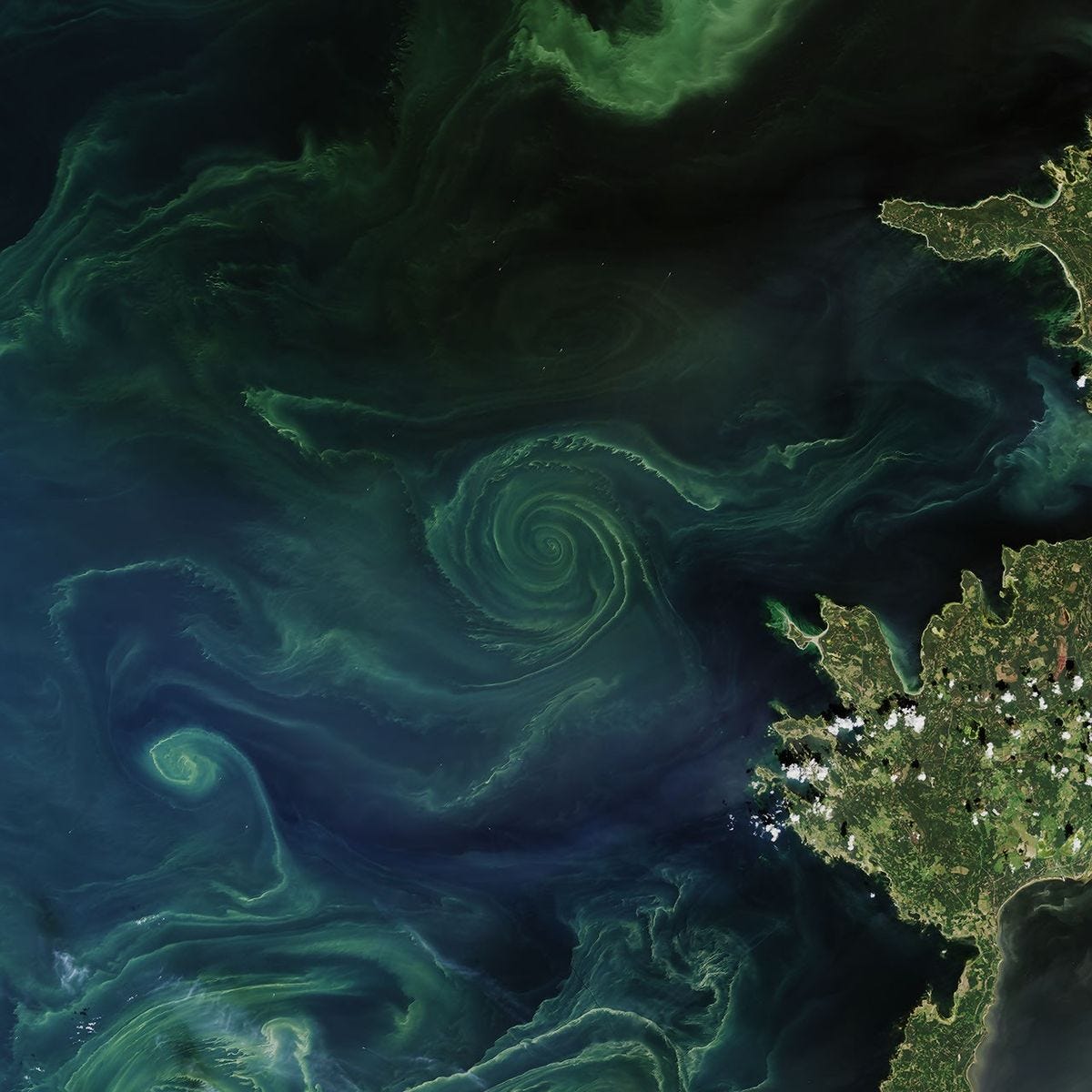
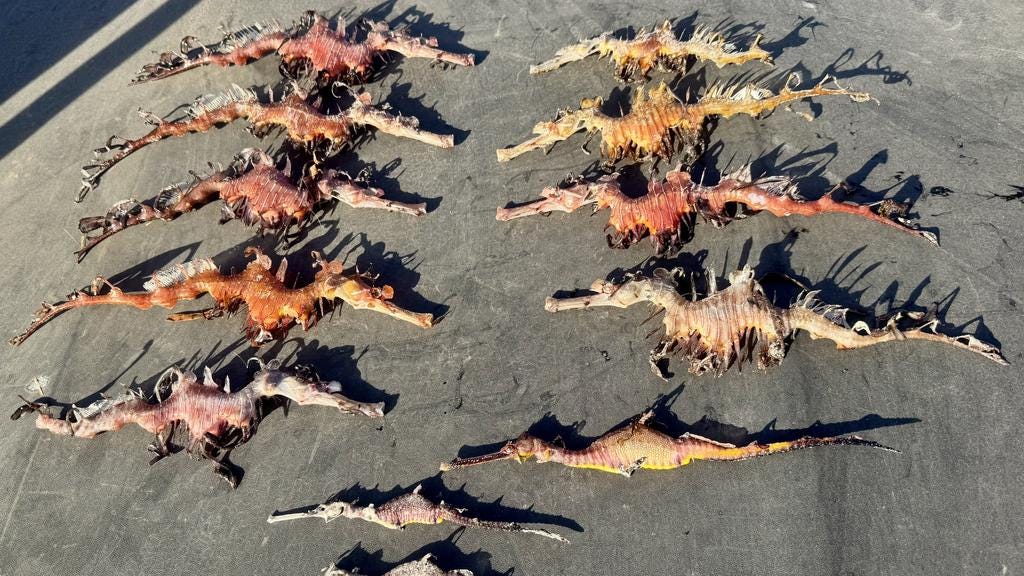
An ecological disaster has been unfolding on Australia’s coast. It is one of the worst algal blooms on record. There are reports of sea life washing up on the beaches at unprecedented scales. Endangered sea dragons, octopus, pipis, rays, and a 3-meter white shark have found themselves in sandy graves.
The microbiome is a pioneer biome, able to rapildy evolve. Microbes have been pioneers of new terrains from emerging forests 450 million years ago to recent bio-geologies of landfills and ocean plastispheres. Bacteria and fungi are planetary entrepreneurs, the first to learn to metabolise new niche materials. Fungi once had to learn to metabolise lignin (the tough, complex polymer that makes wood rigid), before which wood simply accumulated in the earth, compressing over deeptime into the material we now know as coal. Today, landfills harbor microbiomes which have mutated to consume plastics. There is much to learn from the microbes. Their innovations in material processing have histories longer than human industry and its material inventions.
Holobiontic life is a co-creative, generative, extractive, consumptive, productive, violent, caring, sharing, dissolving, cogitating, destroying, composting, mixing, ordering, and disordering, process of which the ‘human’, in the classical sense, is but a fleeting moment, or, series of mutating moments.
What does that make so-called human centred design?
The design process (in our current capitalist set up, at least) rests on the paying client. In such a system, to attend to a non-paying client (non-humans) feels futile. Biodiversity or carbon credits are largely a fraud that simply shirk responsibility. Too much emotional labor is required to serve the more-than-human. But what if we expand our definition of The Human to include those creatures we find ourselves entangled with today. To the microbes. The microbes who make delicious cheese, who influence our genes and brains, who constitute and reconstitute our oceans and atmosphere, and who bloom at the edges of normal to reveal the destabilisations of our shared world.
Human centred design really demands we attend both downward to the tendrils of the human holobiont and upward to the planetary biosphere and outward to the sympoetic relations between plants, animals, fungi and bacteria. To truly comprehend this entanglement could shift our understanding of the human so radically that caring for the planet would no longer require a sense of deep empathy or righteous sense of responsibility - it would be in everyone's best interest to serve our ancient, multispecies planetary pickling.
Vuong, H. E., Yano, J. M., Fung, T. C., & Hsiao, E. Y. (2017). The microbiome and host behavior. Annual Review of Neuroscience, 40, 21–49. https://doi.org/10.1146/annurev-neuro-072116-031347
Rees T,Bosch T,Douglas AE(2018) How the microbiome challenges our concept of self. PLoS Biol16(2): e2005358. https://doi.org/ 10.1371/journal.pbio.2005358
Sender R, Fuchs S, Milo R (2016) Revised Estimates for the Number of Human and Bacteria Cells in the Body. PLoS Biol 14(8): e1002533. https://doi.org/10.1371/journal.pbio.1002533
Zhang, Q., Chen, B., Zhang, J. et al. Effect of prebiotics, probiotics, synbiotics on depression: results from a meta-analysis. BMC Psychiatry 23, 477 (2023). https://doi.org/10.1186/s12888-023-04963-x
Romano, S., Wirbel, J., Ansorge, R. et al. Machine learning-based meta-analysis reveals gut microbiome alterations associated with Parkinson’s disease. Nat Commun 16, 4227 (2025). https://doi.org/10.1038/s41467-025-56829-3
Mudge, M.C., Riffle, M., Chebli, G. et al. Harmful algal blooms are preceded by a predictable and quantifiable shift in the oceanic microbiome. Nat Commun 16, 3986 (2025). https://doi.org/10.1038/s41467-025-59250-y